On May 4, 1970, a troop of National Guardsmen shot fifty-six M1-armor-piercing bullets directly into a crowd of student protesters, killing four of them and severely wounding nine others. The Guard had been sent to quell student demonstrations against the war in Vietnam, but the presence of armed men served only to increase the students’ anger. I was fourteen years old, and saw the resulting outrage and eruption of student protests that followed. I believed it was a turning point against the war in Vietnam. In fact, the war did not end until I was a sophomore in college, five years later.
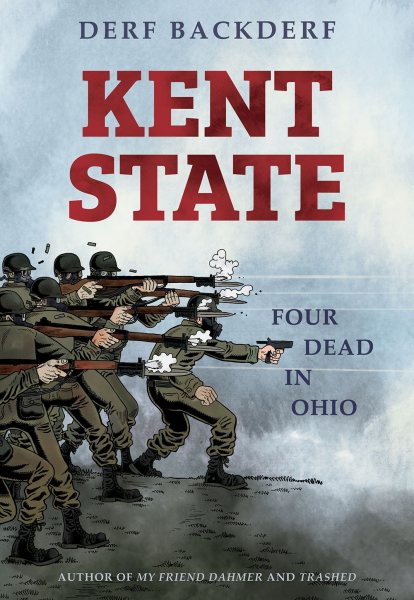
Derf Backderf was ten years old at the time, and living in the next town over. He saw the truckloads of Guardsmen patrolling his own town. He became an award-winning journalist who produces, essentially, documentaries in graphic novel form. His graphic novel detailing the five days leading up to the Kent State incident is a “dramatic recreation” based on “eyewitness accounts, detailed research, and investigation.”
Kent State follows the mundane lives of several students, including the actions and opinions of the four students who were killed—or at least what could be pieced together later from interviews with their friends and family. It follows the testimony of a student who claimed at the time to be an FBI campus informant, but may not have been. It also documents the incident through the eyes of the only National Guardsman ever willing to speak about the tragedy.
Kent State assembles a picture of fearful confusion, hatred born of possibly-deliberate misinformation, and an absolute refusal of anyone in power to take responsibility or even give a clear command. The book is a stunning and wrenching account of the evolution and eventual cost of mutual paranoia and misunderstanding.
Disclaimer: I read Kent State and wrote this review in the days following the ICE murder of Alex Pretti in Minneapolis.
These days, we have a different set of lies, misdirections, and paranoid notions. The government has decided that protestors are terrorists rather than communists. We have scared, inappropriately-trained boys under the command of bitter, hardened men, but now they are signing up as ICE agents instead of escaping the draft by enlisting in the National Guard. Some of us dare to call the deaths “murders” instead of “killings,” though heavily-armed men still claim to be in fear for their lives at the hands of peaceful but angry protesters.
The murders at Kent State were never punished. There were a series of cover-ups—false claims of hordes of students charging the Guardsmen; mixed up or hidden ballistic evidence; judges acquitting Guardsmen for no reason; politicians telling outright lies. No Guardsmen ever admitted to any wrongdoing, though several student protesters were jailed. The general public blamed the students.
The book is essential reading for those who wish to continue an ongoing fight for justice. We now have video cameras on every phone instead of eyewitness reports, so perhaps we will be more successful. But it has never been without cost. Richard Nixon was later taped saying, “You know what stops them? Kill a few. Remember Kent State?” He was speaking about the civil rights protests in 1971. Nixon resigned, but not until 1974. His legacy of distrust and hatred obviously still lives on. It has been and still will be a long road.
4 Comments
Leave a reply →